
Strawberry Gazette
Essay by Terence Lyons

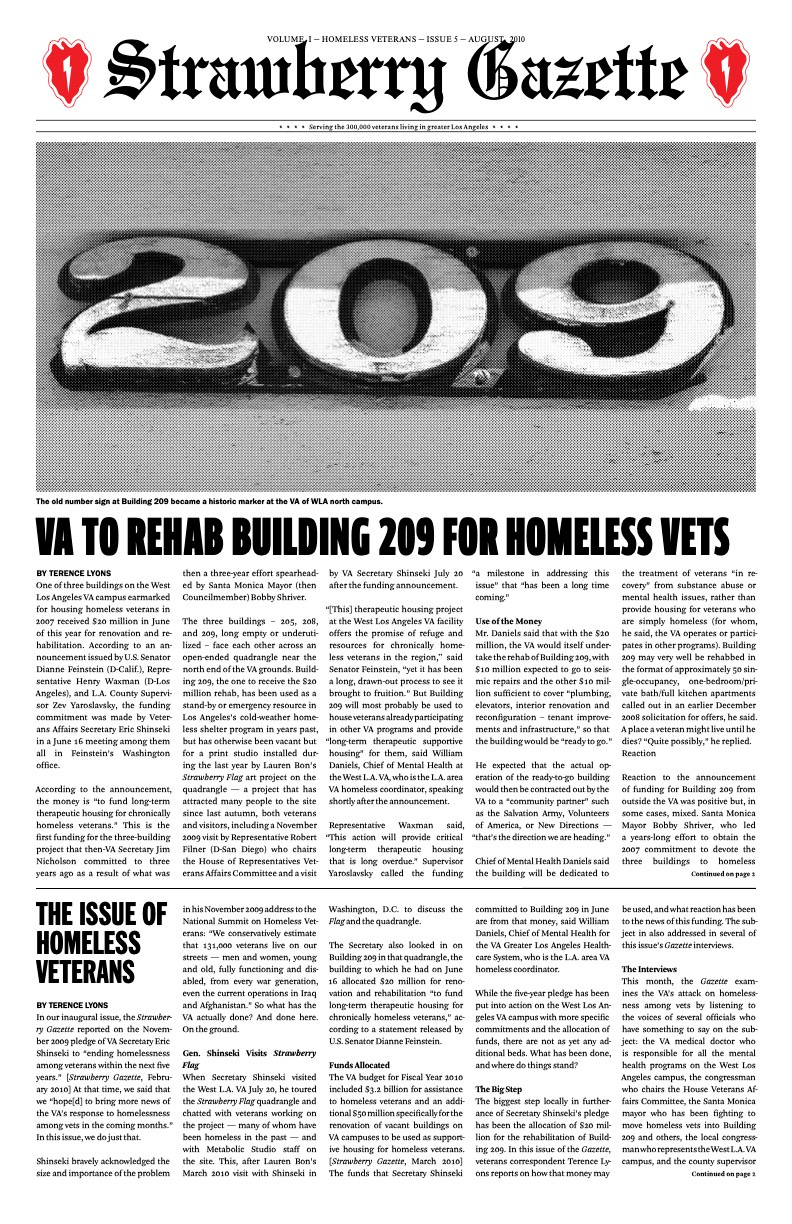
As part of Metabolic Studio’s Strawberry Flag project (2010-2012), an engagement with the Veterans Affairs Medical Center and campus in West Los Angeles and the veterans housed there, Metabolic Studio worked with veterans to create the Strawberry Gazette (later the Strawberry Bulletin). This newspaper was originally printed in the print shop created as part of Strawberry Flag, with writings about the issues the veterans were facing, often written by the participants themselves. Every issue is available for download on the Metabolic Studio website.
To highlight this work, we are reposting an essay by Terence Lyons, the paper’s Veterans Correspondent, who was a regular contributor and was living on the West LA VA campus at the time. This essay was drawn from the March 2012 Introduction to Preserving a Home for Veterans, Les Figues Press, 2012.
Preserving a Home for Veterans is an adaptation of the Metabolic Studio’s January 2011 position paper on the Department of Veterans Affairs use of its largest land asset — the West Los Angeles campus. In 1888, this land was donated to the federal government with the promise that it would be used as a permanent home for veterans. This publication details the VA’s practice of leasing parts of the property to private entities in violation of the 1888 deed and in spite of the fact that there were more than twenty thousand homeless veterans living in Los Angeles County at that time. After investigating the abandoned buildings on the property and learning of the Deed of 1888, the veterans and artists, working with the Metabolic Studio’s legal counsel, penned the position paper.
The paper was used by the ACLU and other lawyers in a lawsuit against the VA, which resulted in a January 2015 settlement that included the VA's commitment to permanent housing on the West LA campus and the development of a new master plan for the property. Equal parts legal document, historical report, socially engaged artist statement and activist call-to-action, this is one facet of Metabolic Studio's Strawberry Flag action.
From the summer of 2009 until October 2010, I experienced a remarkable artwork on a lawn framed by vacant and under-purposed buildings near the northernmost reaches of the West Los Angeles Veterans Administration (West LA VA) property.
It was during this period that Lauren Bon and the Metabolic Studio installed and nurtured an aquaponic strawberry farm in the shape of a very large American flag — nearly one thousand strawberry plants sat in perforated white piping that was mounted horizontally, at chest height.
Bon and the Studio salvaged the plants from a farm where they would otherwise have been plowed under after bearing only one crop. The water that coursed through the piping and nourished the plants was reclaimed from the Los Angeles River and stored on-site in a large military-surplus water bladder. The pumps that drove the water through the pipes were powered by batteries charged by veterans who pedaled stationary bicycles in the shade of solar panels.
The Strawberry Flag was tended by artists and by veterans employed through the VA Compensated Work Therapy (CWT) program. But the Flag was not just a living sculpture to be observed and admired. It became the focal point of a community of veterans, clinicians, and visitors. As a veteran living at the West LA VA in 2009, I became a part of that community.
Bon and the Studio refurbished a kitchen in one of the under-purposed buildings, Building 208, so that CWT veterans could cook harvested strawberries into preserves. Other CWT vets cleaned out space in the vacant adjacent Building 209 for a print studio, where they made labels for the jam jars. And the print studio printed not only jam labels but also artworks and custom T-shirts at weekly veterans' workshops. The kitchen was also used to bake pastries, which were served with tea every weekday afternoon at the Flag. (And the kitchen was a great place to hang out — they even brought in an upright piano.)
Political and community leaders joined veterans, clinicians, and artists at more-or-less-monthly al fresco High Tea events (with proper linen and tableware, a touch not seen at the VA since bygone days). On summer weekends, the Studio sponsored “Strawberry Sundays,” open-mic events at which vets read poetry and made music. Veterans gathered at the Flag on some evenings to join Studio artists in read-throughs of Thornton Wilder’s Our Town and Gore Vidal’s Visit to a Small Planet. One evening, Bon and the Studio staged a Beckett play with major-league talent in “theatre space” cleared by CWT vets in nearly vacant Building 205.
Strawberry Flag has given birth to many progeny as it has moved from object to mythology. Weekly print workshops are ongoing. The Flag’s community newspaper, the Strawberry Gazette, has evolved into the Strawberry Bulletin, which Metabolic Studio still publishes regularly. The strawberry farm is gone, but a plentitude of vegetables are now growing in the Metabolic Studio’s Garden of Defiance behind the State Veterans Home down the hill from the Flag location.
As Bon and the other Studio artists inhabited the West LA VA property, they quite naturally became curious about the history and geography of the place and its people. And that nurtured a similar curiosity among the veterans living there and participating in the community fostered by the Strawberry Flag, myself included.
Out of that curiosity, and the combined talents and intelligence of the artists and veterans, was born another progeny of the Strawberry Flag — the Metabolic Studio position paper titled Preserving a Home for Veterans. To be sure, the considerable expertise and efforts of the Studio’s Philadelphia lawyers also played a major and indispensible role.
The position paper, issued in January 2011, said three things: (1) the 1888 deed by which the West Los Angeles land was transferred for a veterans home created a trust under which the VA holds the land with fiduciary duties to use it only for its intended purpose; (2) the VA now puts much of the land to non-veteran-related uses in breach of the trust; and (3) the VA has entirely “hospitalized” the veteran-related uses and abandoned the other functions of a veterans home, also in breach of the trust.
Although the position paper spoke about legal principles, it was not simply a legal brief. As Lauren Bon wrote in a guest editorial in a local community newspaper: “The Brentwood News specifically asked me about ‘the legal actions you are contemplating.’ I am not contemplating any legal actions. The position paper is meant to open up a discussion as to how we can better serve the numbers of people who are the human cost of war.”
When the VA made it clear that it did not wish to engage in such an open discussion, the American Civil Liberties Union (ACLU) of Southern California and other lawyers filed a class-action lawsuit in June 2011 challenging the VA’s West LA land use. In a press release issued the day that suit was filed, the plaintiffs’ lawyers said, “The misuse of the West Los Angeles campus is documented in detail in a Position Paper issued in January 2011 by the Metabolic Studio, a direct charitable activity of the Annenberg Foundation led by artist Lauren Bon, entitled ‘Preserving a Home for Veterans.’”
As this book goes to press in March 2012, the lawsuit filed in June 2011 is pending in the Los Angeles federal court. The VA defendants have made a motion to dismiss the case, now awaiting decision, arguing that even if the plaintiffs’ “allegations about discrimination, breach of trust, and procedural error” are all true, “this case must be dismissed.” Although the motion says the VA “has as a top priority the resolution of the housing needs of homeless Veterans,” it also says that actually providing that housing is not its responsibility.